Mindfulness Exercises for Anxiety: 8 Practices to Try
Researched and Written by Still You Editorial Team · Last updated: May 7, 2026
Try 8 mindfulness exercises for anxiety, from 60-second grounding to body scans, with evidence-informed tips and safety notes.
Still You Editorial Team
Wellness Research Team
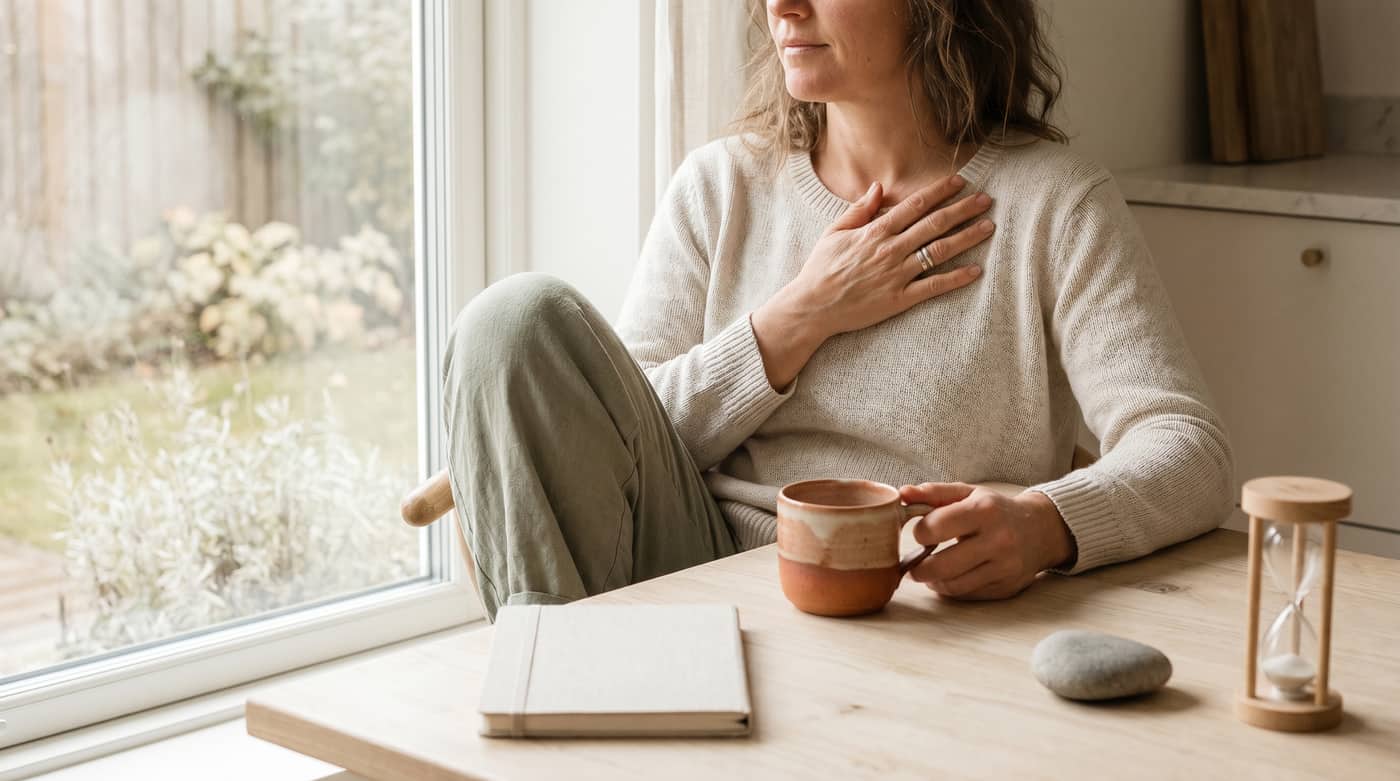
Mindfulness exercises for anxiety work best when they are small enough to use while anxiety is actually happening. You do not need a silent room, a perfect posture, or a clear mind. You need one reliable way to move attention out of the threat story and back into what is happening now.
Try these when your chest tightens, your thoughts speed up, or you notice yourself rehearsing the same worry again and again. They are not a treatment plan. They are practical self-regulation drills you can use alongside therapy, medication, sleep work, or whatever support already helps you stay well.
Key Takeaways
- The most useful mindfulness exercise is the one that matches your anxiety pattern: racing thoughts, body tension, panic, shutdown, or worry loops.
- Research suggests mindfulness-based programs may reduce anxiety symptoms, but the evidence is stronger for structured programs than for every short standalone exercise.
- Start with 60 seconds. Consistency matters more than doing a long session once.
- If quiet meditation feels worse, use eyes-open grounding, walking, or a tool with gentle prompts.
First, match the exercise to the anxiety pattern
Anxiety is not one single experience. Sometimes it is a mind problem: thoughts, predictions, imaginary conversations. Sometimes it is mostly body: heat, tight chest, shaky hands, a stomach that feels like it dropped through the floor.
Use this as a quick picker.
| If anxiety feels like... | Try first | Why it fits |
|---|---|---|
| Racing thoughts | Thought labeling | It creates distance from the mental loop. |
| Panic rising fast | 5-4-3-2-1 grounding | It gives your attention a sensory job. |
| Chest or jaw tension | Box breathing | It slows the body before you argue with thoughts. |
| Numb or disconnected | Mindful walking | Movement can feel safer than stillness. |
| Bedtime worry | Body scan | It shifts attention from planning into sensation. |
| Self-criticism | Loving-kindness phrases | It softens the tone of your inner voice. |
| Too many worries | Worry-to-action note | It separates solvable tasks from rumination. |
If you already know you are prone to panic, read panic attack vs anxiety attack as a companion. The skills overlap, but the safety plan may be different.
1. The 60-second breath-and-name reset
This is the smallest place to start.
Sit or stand in a way that lets you breathe normally. Put one hand somewhere neutral: your chest, your belly, the side of your chair, or the edge of the table. Take one slow breath and name what is happening in plain language.
Not a diagnosis. Not a dramatic label. Just a sentence.
Try:
- "Worry is here."
- "My body feels keyed up."
- "This is the replay loop."
- "I am having a prediction thought."
Then feel one full exhale from start to finish. Do that three times.
The point is not to convince yourself that everything is fine. The point is to stop merging with the thought. "I am unsafe" and "I am noticing an unsafe thought" feel different in the body. That gap is where choice returns.
This pairs well with mindfulness and negative thoughts, which goes deeper into the observer stance.
2. 5-4-3-2-1 grounding
Use this when anxiety is loud and you need something concrete.
Name:
- Five things you can see.
- Four things you can feel.
- Three things you can hear.
- Two things you can smell.
- One thing you can taste, or one slow sip of water.
Do not rush through the list like homework. Look at the chair leg. Notice the grain in the wood. Feel the floor through your shoes. Let the exercise be boring on purpose. Anxiety likes abstraction. Grounding gives the mind a physical address.
If you tend to feel unreal, foggy, or far away from your body, use our guide to grounding techniques for dissociation. It is more trauma-sensitive and better suited to that specific experience.
3. Box breathing with attention
Box breathing is usually taught as a breathing technique. It becomes mindfulness when you pay attention to the sensation of each phase instead of just counting.
Use this rhythm:
- Inhale for 4.
- Hold for 4.
- Exhale for 4.
- Hold empty for 4.
Repeat for 3 to 5 rounds.
During each inhale, notice where the breath moves first. During each hold, notice the urge to rush. During each exhale, let your shoulders drop one millimeter. That tiny detail matters. It keeps the practice embodied instead of turning it into another performance.
Box Breathing
A 4-4-4-4 breathing pattern to calm your nervous system.
If you use this at work, box breathing at work covers a more discreet version for meetings, calls, and tense conversations.
4. The body scan before sleep
A body scan is useful when anxiety has moved into tension. Lie down or sit back. Start at your feet and move upward slowly. You are not trying to relax every body part. You are noticing what is already there.
Try this sequence:
- Feet: pressure, temperature, contact with the bed or floor.
- Legs: heaviness, restlessness, pulsing, stillness.
- Belly: tightness, movement, warmth, numbness.
- Chest: expansion, holding, fluttering.
- Face: jaw, tongue, forehead, eyes.
When you find tension, say "tightness" and keep moving. You do not have to fix it. In anxious moments, fixing can become another form of pressure.
If your anxiety shows up mostly at night, connect this with breathing for deep sleep or what to do when you are lying in bed for hours and cannot sleep.
5. Mindful walking
Stillness is not always the kindest starting point. For some people, sitting quietly makes anxiety feel bigger. Walking gives the nervous system a little movement while your attention learns to settle.
Walk slowly enough that you can feel three phases:
- Heel touching down.
- Weight shifting through the foot.
- Toes leaving the floor.
Keep your eyes open. Let your gaze be soft. If thoughts pull you away, return to the footstep you are in. Not the next ten steps. This one.
You can do this in a hallway, outside, beside your bed, or between tasks. Two minutes counts.
6. Thought labeling
Thought labeling is for the moment when anxiety starts sounding intelligent.
You know the tone: "What if this goes badly?" "What if they are upset?" "What if I cannot handle it?" The content may change, but the pattern repeats.
Label the pattern instead of debating the details.
Examples:
- "Planning."
- "Catastrophizing."
- "Mind reading."
- "Replaying."
- "Checking."
- "Self-criticism."
Then come back to one sensation: breath, feet, hands, sound. You are not trying to make the thought disappear. You are teaching the mind that not every thought deserves a meeting.
For a more structured version, use how to stop overthinking. It has a 90-second reset for thought spirals that move fast.
7. Loving-kindness phrases
Anxiety often comes with a hard inner voice. Loving-kindness practice gives you a different voice to rehearse.
Place a hand somewhere steady and repeat:
- "May I be safe in this moment."
- "May I meet this with patience."
- "May I not abandon myself."
- "May I take the next small step."
If those lines feel too soft or false, use plainer language:
- "This is hard, and I can stay with myself."
- "I do not have to solve my whole life right now."
The exact phrase matters less than the tone. You are practicing a way of speaking to yourself that does not add a second layer of fear.
Meditation Timer
Minimalist timer with singing bowl bells for mindful meditation sessions.
8. The two-minute worry-to-action note
Some worries contain an action. Others are just loops wearing a serious face.
Set a timer for two minutes. Write three columns:
| Worry | Can I act on it today? | Next small action |
|---|---|---|
| "I forgot something for tomorrow." | Yes | Check calendar once. |
| "Everyone thinks I failed." | Not directly | Label as mind reading. |
| "I need to reply to that email." | Yes | Draft two sentences. |
Stop when the timer ends. The goal is not to empty the mind. The goal is to sort. Solvable concerns get one small action. Unsolvable loops go back to breath, grounding, or the body scan.
Worry Burner
Write. Burn. Release. A ritual for clearing the mind.
What the research can and cannot say
There is real evidence behind mindfulness, but it is easy to overstate it.
The National Center for Complementary and Integrative Health notes that mindfulness and meditation may help people manage anxiety, stress, depression, pain, and sleep, while also warning that much of the research is preliminary or hard to compare across different practices.
In a JAMA Psychiatry randomized clinical trial, 276 adults with anxiety disorders were assigned to either an 8-week mindfulness-based stress reduction program or escitalopram. MBSR was noninferior to the medication in that study, meaning it had comparable effectiveness for the measured anxiety outcomes. That is encouraging, but it does not mean a two-minute exercise is the same as a structured 8-week program, and it does not mean anyone should stop medication without a clinician.
Earlier research also points in a similar direction. A 2013 randomized trial in generalized anxiety disorder found that MBSR reduced anxiety symptoms compared with stress management education. A meta-analytic review found moderate effects for mindfulness-based therapy on anxiety and depression symptoms, and a later review of mindfulness-based interventions for anxiety and depression described growing evidence across clinical settings.
The careful version is this: mindfulness exercises may support anxiety self-regulation, especially when practiced regularly. They are not a cure, and the evidence is stronger for structured programs than for every quick exercise on the internet.
When to get more support
If anxiety is severe, keeps you from sleeping or working, leads to panic attacks, or makes you feel unsafe, use these exercises as a bridge to support, not as a replacement for it. A therapist, physician, or crisis service can help you build a safer plan.
A simple one-week plan
Do less than you think you should. That is how this sticks.
| Day | Practice | Time |
|---|---|---|
| 1 | Breath-and-name reset | 60 seconds |
| 2 | 5-4-3-2-1 grounding | 2 minutes |
| 3 | Box breathing | 3 minutes |
| 4 | Body scan | 5 minutes |
| 5 | Mindful walking | 3 minutes |
| 6 | Thought labeling | 2 minutes |
| 7 | Pick the one that worked best | 5 minutes |
After each practice, ask one question: "Do I feel one percent more here?"
That is enough. You are not chasing perfect calm. You are building the skill of returning.
Still You does not provide medical advice, diagnosis, or treatment. The information and tools on this site are for educational and self-regulation purposes only and are not a substitute for professional care. If you are experiencing severe or persistent anxiety, please consult a qualified healthcare provider.
Sources
- NCCIH, Meditation and Mindfulness: Effectiveness and Safety
- Hoge et al., Mindfulness-Based Stress Reduction vs Escitalopram, JAMA Psychiatry, 2023
- Hoge et al., Randomized Controlled Trial of Mindfulness Meditation for Generalized Anxiety Disorder, Journal of Clinical Psychiatry, 2013
- Hofmann et al., The Effect of Mindfulness-Based Therapy on Anxiety and Depression, Journal of Consulting and Clinical Psychology, 2010
- Mindfulness-Based Interventions for Anxiety and Depression, Psychiatric Clinics of North America, 2017
Frequently Asked Questions
What is the best mindfulness exercise for anxiety?
The best exercise depends on how anxiety shows up. If your mind is racing, try thought labeling or breath counting. If your body feels wired, try 5-4-3-2-1 grounding, box breathing, or a body scan.
How quickly can mindfulness exercises help anxiety?
Some exercises can help you feel steadier within a minute or two, especially grounding and slow breathing. Longer-term changes usually need repetition. Research on structured programs often studies several weeks of practice, not one isolated session.
Can mindfulness replace anxiety medication or therapy?
No. Mindfulness can support self-regulation, but it should not replace medication, therapy, diagnosis, or professional care. If anxiety is severe, persistent, or limiting your life, talk with a qualified clinician.
What if mindfulness makes me more anxious?
That can happen, especially if quiet practice makes body sensations or memories feel louder. Try eyes-open grounding, walking, or shorter sessions. If practice feels overwhelming or trauma-related, work with a trauma-informed professional.
How long should I practice each day?
Start with 2 to 5 minutes. A short practice you can repeat is usually more useful than a long session you avoid. Build toward 10 minutes only when it feels manageable.
Is mindfulness the same as meditation?
Mindfulness is present-moment awareness without harsh judgment. Meditation is one way to train it. You can practice mindfulness while breathing, walking, journaling, washing dishes, or sitting with a timer.
Download Still You
Experience guided breathwork, sleep stories, and mindfulness sessions. Your sanctuary for inner peace.
Researched and Written by Still You Editorial Team
Wellness Research Team
Our editorial team collaborates on every article, combining research from peer-reviewed sources with insights from meditation teachers and health writers.
Continue Your Journey
Mindfulness and Negative Thoughts: A Practice Guide
Learn the observer stance and 60-second thought labeling to change your relationship with negative thinking. Science-backed mindfulness techniques.
Spirituality and Meditation: Path to Inner Peace
How spirituality and meditation connect without religious belief. A science-backed guide to deepening inner awareness and consciousness.

How to Stop Overthinking: 5 Techniques That Work Now
Stop thought spirals instantly with neuroscience-backed techniques. Learn the 90-second reset, box breathing, and a 3-minute practice you can try right now.