Breathing Exercises for Anxiety: 5 Research-Supported Techniques to Try
Researched and Written by Still You Editorial Team · Last updated: May 9, 2026
Try 5 breathing exercises for anxiety, with steps, safety notes, and research-backed tips for choosing cyclic sighing, box breathing, 4-7-8, and more.
Still You Editorial Team
Wellness Research Team
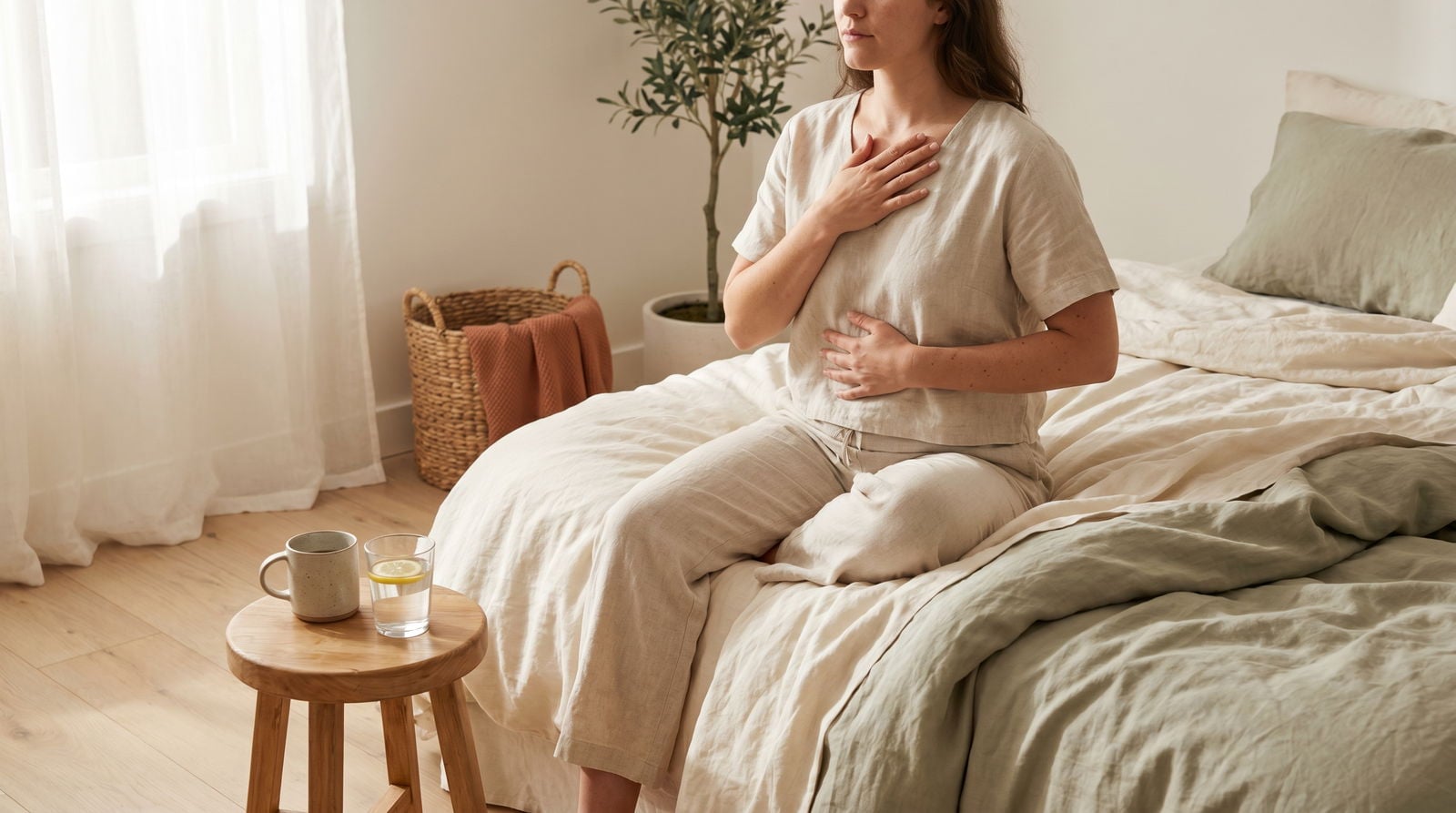
Breathing exercises for anxiety may help when your body is already acting like something is wrong: fast breath, tight chest, clenched jaw, restless hands. The move is smaller than "calm down." Give your nervous system a simple rhythm it can follow for a few minutes.
Start small. Two minutes is enough to learn the pattern. Five minutes is enough for many practices to feel different in the body. If breathing exercises make you dizzy, panicky, or more focused on symptoms, stop and use grounding instead.
Key Takeaways
- Breathing exercises may support anxiety self-regulation, especially when practiced repeatedly and gently.
- Cyclic sighing has direct RCT evidence in healthy adults, while slow breathing and diaphragmatic breathing are supported by broader reviews and health-organization guidance.
- The best technique is the one that fits the moment: fast body alarm, shallow breathing, work stress, bedtime anxiety, or panic sensitivity.
- Breathwork is a support tool, not a replacement for therapy, medication, emergency care, or professional diagnosis.
Choose the exercise that fits the anxiety
Anxiety does not always need the same breath pattern. Use this table as a quick picker before you start.
| If anxiety feels like... | Try first | Why it fits |
|---|---|---|
| Fast body alarm | Cyclic sighing | It emphasizes a long, complete exhale. |
| Chest tightness | Belly breathing | It moves attention lower in the body. |
| Work stress | Box breathing | It gives the mind a simple counting task. |
| Bedtime worry | Long-exhale breathing | It slows the exhale without much effort. |
| Panic sensitivity | Gentle 5-count breathing | It avoids long holds and dramatic breath changes. |
If you are not sure, begin with the gentlest option: breathe in for 4, breathe out for 5, and repeat for two minutes. You can always move to a more structured pattern later.
If anxiety is mostly thoughts, pair this article with mindfulness exercises for anxiety. If it feels like acute panic, read panic attack vs anxiety attack so you can tell the difference between a gradual anxiety build and a sudden panic spike.
What research can and cannot say
The evidence is promising, but it is not magic.
A 2023 meta-analysis in Scientific Reports found that breathwork was associated with lower self-reported stress, anxiety, and depressive symptoms compared with control conditions. The anxiety effect was small to moderate, and the authors urged caution because many studies had moderate risk of bias.
The honest research summary
Breathing practices may help with self-reported anxiety and stress, especially slow or regulated patterns. The evidence is stronger for short-term symptom support than for claims that any single technique treats anxiety disorders on its own.
A 2023 review of breathing practices for stress and anxiety looked at 58 studies and found that many interventions were effective, but results varied by training quality, duration, population, and technique. Another review focused on clinically diagnosed anxiety disorders found emerging support, while also pointing out that the field still needs better trials.
So keep the claim modest: breathing exercises can be useful, accessible tools. They are not proof that anxiety is "all in your breath," and they should not be sold as a replacement for care.
1. Cyclic sighing for a fast body alarm
Cyclic sighing is the first pattern I would try when anxiety feels physical: quick breath, hot face, restless energy, a body that keeps scanning for danger.
Here is the pattern:
- Inhale through your nose.
- Before you exhale, take a second small inhale to top up the lungs.
- Exhale slowly through your mouth until the breath feels complete.
- Repeat for 2 to 5 minutes.
Stanford researchers tested cyclic sighing against other controlled breathing practices and passive mindfulness meditation in healthy adults. Participants practiced five minutes a day for one month. All groups improved, but cyclic sighing showed the strongest improvement in positive mood and reduced resting breathing rate.
Use the result carefully. The study did not prove cyclic sighing treats clinical anxiety disorders, and it excluded people with moderate to severe psychiatric conditions. Still, it gives a practical reason to try this pattern when your body is revved up.
Make it gentler
If the double inhale feels strange, use one normal inhale and a longer exhale. The long, unforced exhale is the part most people can use right away.
2. Belly breathing when anxiety moves into your chest
Belly breathing, also called diaphragmatic breathing, is useful when anxiety pulls your breath high into the chest. The goal is not to stuff the lungs with air. It is to let the lower ribs and belly participate again.
Try this:
- Sit back or lie down.
- Put one hand on your upper chest and one hand on your belly.
- Inhale through your nose and let the lower hand move first.
- Exhale slowly through your mouth.
- Repeat for 5 minutes, or stop sooner if you feel strained.
The American Lung Association describes belly breathing as a way to slow breathing and use less energy to breathe. The NHS gives a similar gentle pattern for stress, anxiety, and panic: let the breath move down into the belly as much as comfortable, breathe in through the nose and out through the mouth, and keep going for at least a few minutes.
If your chest is tight, do not turn this into a contest. Smaller breaths are allowed. The phrase "deep breathing" can make people overbreathe, which may increase lightheadedness. Think low and slow, not huge.
3. Box breathing when you need calm and focus
Box breathing is often the easiest pattern for work anxiety because it gives the brain something square to hold.
Use the classic 4-4-4-4 rhythm:
- Inhale for 4.
- Hold for 4.
- Exhale for 4.
- Hold empty for 4.
Repeat for 3 to 5 rounds. If that feels easy, continue for 2 to 5 minutes.
The counting is part of the benefit. Anxiety loves vague, unfinished loops. Box breathing gives your attention four short jobs and repeats them. That can be enough to get through the first wave of stress before you decide what to do next.
Box Breathing
A 4-4-4-4 breathing pattern to calm your nervous system.
If you want a work-specific version, use box breathing at work. It covers how to breathe discreetly at a desk, in a meeting, or before a difficult call.
4. Long-exhale breathing for bedtime anxiety
Long-exhale breathing is helpful when you do not want a complicated method. The rule is simple: make the exhale a little longer than the inhale.
Start with this:
- Inhale for 4.
- Exhale for 6.
- Repeat for 2 minutes.
If that feels comfortable, you can try 4-7-8:
- Inhale through your nose for 4.
- Hold for 7.
- Exhale through your mouth for 8.
- Repeat for 3 to 4 rounds.
The American Heart Association describes 4-7-8 breathing as one common controlled-breathing approach and notes that a longer exhale may help bring on parasympathetic "rest and digest" activity. That does not mean the exact counts are sacred. If 4-7-8 feels too long, use 3-4-6 or 4-5-6.
For sleep-specific breathwork, read breathing for deep sleep or try the 4-7-8 breathing tool.
5. Gentle 5-count breathing when breath focus feels risky
Some people get more anxious when they focus on breathing. That does not mean you failed. It means you need a less intense version.
Use the NHS-style 5-count pattern:
- Sit, stand, or lie down with support.
- Breathe in gently and count from 1 to 5.
- Breathe out gently and count from 1 to 5.
- Keep the breath easy rather than impressive.
- Continue for 2 to 5 minutes.
No breath holds. No forced inhales. No dramatic exhales.
This is also a good choice if you are prone to panic sensations. Breath holds and very long exhales can be useful for some people, but they can feel too intense if your anxiety is already tracking every body signal. In that case, make the practice boring on purpose.
If you need something that does not center the breath at all, use grounding techniques for dissociation or the panic button for sensory grounding.
Panic Button
Instant sensory deprivation. Darkness and calm audio when you need it most.
A simple 7-day plan
Do not test five techniques in one anxious afternoon and declare the whole thing useless. Give each pattern a fair, small trial while you are relatively calm.
| Day | Practice | Time |
|---|---|---|
| 1 | Gentle 5-count breathing | 2 minutes |
| 2 | Belly breathing | 5 minutes |
| 3 | Box breathing | 3 minutes |
| 4 | Cyclic sighing | 3 minutes |
| 5 | Long-exhale breathing | 3 minutes |
| 6 | Your best pattern so far | 5 minutes |
| 7 | Best pattern plus one note | 5 minutes |
After each practice, write one sentence:
- "Before: my body felt..."
- "After: my body felt..."
- "Next time I would change..."
The note matters because anxiety makes memory unreliable. You may forget that one technique helped by 10 percent. That 10 percent is worth keeping.
If your anxiety turns into repetitive worry, try the worry burner after breathing. Breath can lower the volume. Writing can sort what is actually actionable.
Worry Burner
Write. Burn. Release. A ritual for clearing the mind.
Common mistakes that make breathing exercises feel worse
Most bad breathwork sessions have one thing in common: too much effort.
Avoid these:
- Forcing huge inhales when your body wants smaller breaths.
- Holding your breath until you feel air hunger.
- Practicing only during panic and never while calm.
- Treating dizziness as proof the exercise is "working."
- Using breathwork to avoid problems that need action, boundaries, medication, therapy, or rest.
Breathing exercises work best as a bridge. They can help you get enough steadiness to make the next good decision: send the message, leave the room, drink water, use grounding, go to bed, call someone, or ask for help.
When to stop or get more support
Stop the exercise if you feel dizzy, numb, unusually short of breath, chest pain, worsening panic, or a sense that you are pushing past your body. Return to normal breathing. Look around the room. Put your feet on the floor. Name five things you can see.
Medical note
If you have a heart or lung condition, panic disorder, trauma symptoms, pregnancy-related concerns, or a history of fainting, keep breathwork gentle and check with a qualified clinician before using breath holds or intense practices.
If anxiety is severe, persistent, or interfering with sleep, work, relationships, or basic care, breathing exercises are not enough on their own. They can support professional care, but they should not replace it.
Start with two minutes
Pick one pattern for today.
If your body is racing, try cyclic sighing. If your chest is tight, try belly breathing. If you need to stay calm and functional, try box breathing. If you are in bed, lengthen the exhale. If breath focus makes anxiety louder, use the gentle 5-count pattern or switch to grounding.
The first goal is modest: feel one notch more here. Not cured. Not transformed. Just here enough to choose what happens next.
Still You does not provide medical advice, diagnosis, or treatment. The information and tools on this site are for educational and self-regulation purposes only and are not a substitute for professional care. If you are experiencing severe or persistent anxiety, panic attacks, chest pain, shortness of breath, or thoughts of self-harm, please seek qualified medical, mental health, emergency, or crisis support.
Sources
- Fincham et al., "Effect of breathwork on stress and mental health: A meta-analysis of randomised-controlled trials," Scientific Reports, 2023
- Anderson et al., "Breathing Practices for Stress and Anxiety Reduction," Brain Sciences, 2023
- Zaccaro et al., "Breathwork Interventions for Adults with Clinically Diagnosed Anxiety Disorders," Brain Sciences, 2023
- Stanford Medicine, "'Cyclic sighing' can help breathe away anxiety," 2023
- NHS, "Breathing exercises for stress"
- American Heart Association, "It's not just inspiration - careful breathing can help your health"
- American Lung Association, "Breathing Exercises"
Frequently Asked Questions
What is the best breathing exercise for anxiety?
The best breathing exercise depends on how anxiety shows up. Cyclic sighing may fit a fast body alarm, box breathing may fit work stress, and belly breathing may fit chest tightness or shallow breathing.
How quickly can breathing exercises help anxiety?
Some people feel steadier within a few minutes, especially with slow breathing or long exhales. The research is stronger for repeated practice than for one isolated breath exercise.
How long should I do breathing exercises for anxiety?
Start with 2 to 5 minutes. Many studies and health guides use sessions around 5 to 10 minutes, but comfort matters more than forcing a target.
Can breathing exercises stop a panic attack?
They may help some people slow panic-related breathing, but they are not guaranteed to stop panic. If focusing on the breath makes panic worse, switch to grounding and seek professional support.
Can breathing exercises replace therapy or medication?
No. Breathing exercises can support self-regulation, but they do not replace therapy, medication, diagnosis, crisis care, or a personalized plan from a qualified clinician.
Are breathing exercises safe for everyone?
They are low-risk for many people, but breath holds, long exhales, or intense breathwork can feel uncomfortable. People with heart, lung, panic, trauma, or medical conditions should practice gently and ask a clinician if unsure.
Download Still You
Experience guided breathwork, sleep stories, and mindfulness sessions. Your sanctuary for inner peace.
Researched and Written by Still You Editorial Team
Wellness Research Team
Our editorial team collaborates on every article, combining research from peer-reviewed sources with insights from meditation teachers and health writers.
Continue Your Journey
Breathing for Deep Sleep: 3 Techniques + Free Tool
3 breathing techniques matched to your sleep problem. Racing mind, tension, or can't wind down — pick your pattern and try our free breathing tool.
Breathing Exercises for Anger: Cool Down in 60 Seconds
Learn 3 research-backed breathing techniques that interrupt anger in under 60 seconds. The body-first approach to rage that therapists rarely teach.
Breathwork Techniques: Complete Guide & Exercises
Master breathwork with our complete guide. Learn box breathing, 4-7-8, diaphragmatic breathing, and more science-backed techniques for stress relief and focus.