Breathing Exercises for Anger: Cool Down in 60 Seconds
Researched and Written by Still You Editorial Team · Last updated: May 7, 2026
Learn 3 research-backed breathing techniques that interrupt anger in under 60 seconds. The body-first approach to rage that therapists rarely teach.
Still You Editorial Team
Wellness Research Team
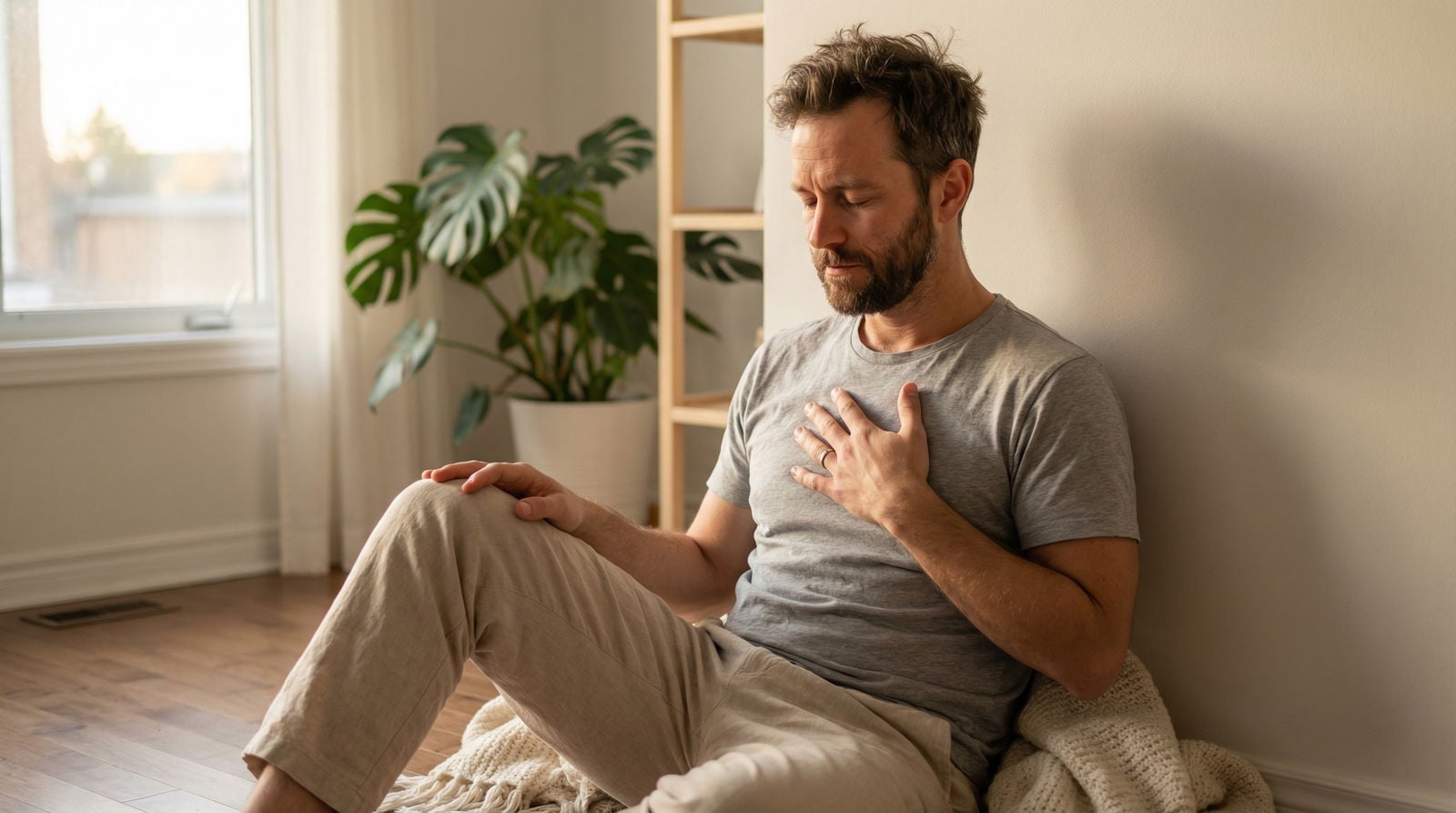
Breathing Exercises for Anger: Cool Down in 60 Seconds
I was mid-argument with a customer service representative when I noticed my chest had turned into a drum solo. Shallow, rapid breaths. Jaw clenched so hard my molars ached. The representative was explaining their return policy for the third time, and I could feel the heat rising up my neck like a cartoon thermometer about to explode.
Then I remembered: anger has a breathing pattern. And breathing patterns can be interrupted.
I held the phone away from my face, took one long exhale — longer than felt natural — and something shifted. Not my opinion about their terrible return policy. But the stranglehold the rage had on my nervous system loosened just enough for me to think clearly again.
That's what this article is about. Not cognitive reframing. Not counting to ten. Not visualizing your anger as a cloud floating away. Immediate physiological intervention — the kind that works in 60 seconds or less because it targets the biological machinery of anger before your thinking brain even gets involved.
Key Takeaways
- Anger creates a specific breathing pattern: shallow, rapid chest breathing that activates your sympathetic nervous system and keeps rage alive
- Arousal-decreasing breathing exercises reduce anger and aggression with an effect size of g = -0.63 — a large, clinically significant reduction across 154 studies with 10,189 participants
- Cyclic sighing (emphasizing long exhalations) produces 33% greater mood improvement than mindfulness meditation according to Stanford research with 108 participants
- The vagus nerve is your body's built-in anger off-switch — controlled breathing stimulates it directly through both ascending and descending pathways
Feeling It Right Now?
If you're angry and need to calm down before reading — start here. Our free Box Breathing tool guides you through 4-count inhales, holds, and exhales with a visual circle. No setup, no signup. Just breathe along for 5 minutes and come back when you're ready.
Box Breathing
A 4-4-4-4 breathing pattern to calm your nervous system.
Why Anger Changes Your Breathing Pattern (And How to Reverse It)
Here's what happens in your body when anger hits: your sympathetic nervous system floods your bloodstream with adrenaline and cortisol. Your heart rate spikes. Blood vessels constrict. And your breathing shifts into a pattern designed for fighting or fleeing — short, shallow, rapid breaths centered in your upper chest.
This isn't psychological. It's mechanical.
The problem is that this breathing pattern doesn't just respond to anger — it actively maintains it. Shallow chest breathing sends continuous danger signals to your amygdala, the brain's threat-detection center. Your amygdala interprets rapid breathing as confirmation that yes, there IS a threat, and yes, you should stay angry.
It's a feedback loop. Anger creates shallow breathing. Shallow breathing reinforces anger. Unless you interrupt the pattern, you're stuck in what researchers call the "anger spiral."
The good news: breathing is one of the few autonomic functions you can consciously control. You can't directly slow your heart rate or lower your blood pressure through willpower alone. But you can change your breath. And when you change your breath, everything else follows.
The Meta-Analysis
A 2024 meta-analysis by Kjærvik & Bushman examined 154 studies with 10,189 participants and found that arousal-decreasing activities — including deep breathing, mindfulness meditation, and progressive muscle relaxation — produced a large, statistically significant reduction in both anger and aggression. The effect size was g = -0.63, meaning the average person practicing these techniques experienced anger levels 0.63 standard deviations lower than control groups.
Stephen Porges, the researcher who developed Polyvagal Theory, describes the vagus nerve as a "vagal brake" — a regulatory mechanism that, when appropriately activated, promotes calmness, social engagement, and physiological stability. Controlled breathing is how you activate that brake.
When you deliberately slow your breathing and emphasize exhalations, you stimulate the vagus nerve through two pathways:
The direct route: Slow breathing with long exhalations triggers vagal efferent (descending) pathways from your prefrontal cortex. This increases vagal activity, which slows your heart rate, lowers blood pressure, and inhibits the sympathetic nervous system that's keeping you in fight-or-flight mode.
The indirect route: The vagus nerve sends afferent (ascending) signals back to your brain, continuously transmitting "relaxation" information to your amygdala and hippocampus. This creates what researchers call a "loop of relaxation" — a positive feedback cycle that counteracts the anger spiral.
The techniques below exploit these pathways. They're not about "finding your calm" or "centering yourself." They're about hijacking your nervous system's control panel and manually switching it from threat mode to safety mode.
The 4-7-8 Breath Interrupts Rage in 60 Seconds
The 4-7-8 technique was popularized by Dr. Andrew Weil, but the pattern itself is ancient — it's based on pranayama breathing from yoga traditions. What makes it effective for anger is the extended exhalation phase, which maximally stimulates the vagus nerve and forces your body out of sympathetic dominance.
Here's the pattern:
- Inhale through your nose for 4 counts
- Hold your breath for 7 counts
- Exhale completely through your mouth for 8 counts
That exhale is twice as long as the inhale. That ratio matters. Research by Balban et al. (2023) shows that respiratory rate reduction is inversely correlated with improvements in positive affect (r = -0.24, p < 0.05) — the slower you breathe, particularly on the exhale, the better your mood improves.
The hold in the middle serves a different purpose. When you're angry, you're likely hyperventilating slightly, expelling too much carbon dioxide. Low CO₂ levels (hypocapnia) can trigger what's called a "false suffocation alarm" in the amygdala — your brain thinks you're not getting enough air, which increases anxiety and anger. The 7-count hold allows CO₂ to normalize, recalibrating your chemoreceptor system.
I use this when I'm already mid-rage. The extended exhale feels like releasing pressure from a valve. The first round rarely does much — I'm usually too worked up. But by the second or third cycle, something shifts. The anger doesn't disappear, but it stops controlling me.
Quick Win
Make the exhale audible. Breathe out through pursed lips like you're blowing out a candle. The sound gives you something to focus on besides the thing that pissed you off, and the slight resistance creates more back-pressure in your airways, which further stimulates the vagus nerve.
One important note: if you feel lightheaded during the hold, shorten it. Start with 4-4-6 if you need to. The extended exhale is what matters most — the hold is secondary. Don't turn this into a breathholding competition with yourself.
Practice: Cool Down an Angry Moment Right Now
Let's do this together. Not hypothetically. Right now.
Think of something that genuinely pisses you off. Maybe it's a recent argument. Maybe it's that coworker who takes credit for your ideas. Maybe it's the state of your inbox. Pick something real — something that makes your jaw tighten when you think about it.
Got it? Now notice your breathing. Don't change it yet — just observe. Chances are it's shallow, maybe centered in your upper chest. Maybe slightly faster than normal.
Now we're going to interrupt that pattern.
Round 1:
- Inhale through your nose: 1, 2, 3, 4
- Hold: 1, 2, 3, 4, 5, 6, 7
- Exhale through pursed lips: 1, 2, 3, 4, 5, 6, 7, 8
Round 2:
- Inhale: 1, 2, 3, 4
- Hold: 1, 2, 3, 4, 5, 6, 7
- Exhale: 1, 2, 3, 4, 5, 6, 7, 8
Round 3:
- Inhale: 1, 2, 3, 4
- Hold: 1, 2, 3, 4, 5, 6, 7
- Exhale: 1, 2, 3, 4, 5, 6, 7, 8
Pause. Check in with your body. The anger probably hasn't vanished — anger doesn't work like that. But notice if the intensity has changed. Has the grip loosened? Can you think about the situation without your heart rate spiking?
That's the point. You're not eliminating anger. You're creating enough space between you and the emotion that you can choose how to respond instead of being hijacked by it.
If three rounds isn't enough, do three more. I've done ten cycles in a bathroom stall at work before an important meeting. No shame in that. Sometimes it takes repetition to override a strong sympathetic response.
Panic Button
Instant sensory deprivation. Darkness and calm audio when you need it most.
Box Breathing Prevents the Anger Spiral Before It Starts
Box breathing (also called square breathing or four-square breathing) is what you use when you can feel anger building but haven't exploded yet. It's preventative medicine for rage.
The pattern is simpler than 4-7-8:
- Inhale for 4 counts
- Hold for 4 counts
- Exhale for 4 counts
- Hold for 4 counts
Equal parts. Equal timing. The symmetry is soothing to your nervous system — there's something about the predictability that signals safety to your amygdala.
Navy SEALs use this technique before high-stress operations. Not because it makes them calm — because it keeps them functional when their sympathetic nervous system is screaming at them to panic. That's the goal here too. Functional. Not zen.
The 2023 Stanford study by Balban et al. with 108 healthy adults found that daily breathing exercises produced significant improvements in mood and anxiety reduction. Box breathing specifically showed a daily increase in positive affect of 1.84 ± 3.24 points on the Positive and Negative Affect Schedule (PANAS). These effects accumulated over time — participants who practiced for 28 days showed sustained improvements.
What makes box breathing different from 4-7-8 is the holds after both inhale AND exhale. This creates what researchers call "respiratory sinus arrhythmia" — your heart rate increases slightly during the inhale holds and decreases during the exhale holds. This variability is actually a sign of healthy vagal tone. The more your heart rate can vary in response to breathing, the better your nervous system can regulate emotional responses.
I use box breathing in the car. Traffic used to be a guaranteed anger trigger for me — every slow driver, every person who didn't use their turn signal, every unnecessary brake tap felt like a personal attack. Now I do box breathing at red lights. Four in, hold four, four out, hold four. By the time the light turns green, I'm annoyed but not enraged. That's progress.
Medical Note
If you have asthma, COPD, or other respiratory conditions, check with your doctor before practicing breath holds. Some people with anxiety disorders also find holds uncomfortable — if that's you, try 4-count breathing without the holds instead (4 in, 4 out, repeat).
The key with box breathing is consistency. One round in a crisis won't do much. But three minutes (12-15 cycles) creates measurable physiological changes. Your heart rate drops. Your blood pressure lowers. The prefrontal cortex — the part of your brain responsible for rational thought — comes back online.
The Physiological Sigh: Your Body's Built-In Anger Reset
Here's something you probably already do without realizing it: the physiological sigh. It's that involuntary double-inhale followed by a long exhale that happens when you've been crying, or after intense stress, or when you're trying to calm down.
Turns out, your body knows what it's doing.
Research from Stanford's Balban et al. (2023) found that cyclic sighing — deliberately practicing this pattern — produces superior improvements in mood and anxiety reduction compared to mindfulness meditation. Participants who practiced cyclic sighing showed a daily increase in positive affect of 1.91 points on the PANAS scale, compared to 1.22 points for mindfulness meditation. That's roughly 33% greater improvement (actually 57% greater, but the key is it's significantly more effective).
The pattern:
- Take a deep inhale through your nose (filling about 75% of your lung capacity)
- Immediately take a second, shorter inhale to completely fill your lungs
- Exhale slowly and completely through your mouth — let it take 8-10 seconds
That double-inhale is the magic part. Your lungs have tiny air sacs called alveoli that sometimes collapse, especially during shallow breathing (which, if you're angry, is exactly what you've been doing). The double-inhale re-inflates collapsed alveoli, allowing for better gas exchange. More oxygen in, more carbon dioxide out, CO₂ levels normalize faster.
The long, slow exhale does what we've been talking about this whole time — maximally stimulates the vagus nerve, activates the parasympathetic nervous system, and tells your amygdala to stand down.
I discovered this technique by accident. I was furious about something — I can't even remember what now — and I noticed myself doing that involuntary sigh-breath. So I did it again. On purpose. Three times in a row. And the anger didn't just decrease — it transformed into something else. Sadness, maybe. Or just exhaustion. The sharp edges softened.
The Stanford researchers found that just five minutes of cyclic sighing per day for 28 days produced sustained improvements in mood and reductions in anxiety. Five minutes is 20-30 cycles. You can do that while making coffee.
The Mechanism
Why does emphasizing exhalation work so well? When you exhale, your heart rate naturally slows due to respiratory sinus arrhythmia. The longer the exhalation, the more pronounced this deceleration. This heart rate variability is directly mediated by the vagus nerve — higher vagal tone means greater heart rate variability, which correlates with better emotional regulation and lower baseline anxiety.
One thing I've noticed: the physiological sigh works better for me when I'm already coming down from anger rather than at the peak. At peak rage, the 4-7-8 breath feels more effective — probably because the longer hold forces a more dramatic interruption. But when I'm in that post-anger hangover phase, where I'm exhausted and shaky and my nervous system doesn't know what to do with itself, cyclic sighing feels like exactly what my body needs.
When Breathing "Doesn't Work" — Troubleshooting the Technique
Let's talk about what happens when you try these techniques and they feel like bullshit.
Because they will. Sometimes.
I've had moments where I'm doing 4-7-8 breathing and my internal monologue is screaming, "THIS ISN'T WORKING, I'M STILL FURIOUS, THIS IS STUPID." That's normal. That's your sympathetic nervous system fighting to stay in control. It doesn't want to calm down — it wants to fight or flee or punch something.
Here's what helps:
1. Extend the practice beyond "one round." One cycle of 4-7-8 breathing takes about 19 seconds. That's not enough time for your nervous system to override a strong sympathetic response. You need 2-3 minutes minimum — that's 6-9 full cycles. Give it time.
2. Make the exhale longer than feels comfortable. If 8 counts doesn't feel long enough, try 10. Or 12. The research shows that slower respiratory rates correlate with greater mood improvements. Push yourself slightly past what feels easy.
3. Add movement. Controlled breathing works better when combined with gentle movement. Walk slowly while doing box breathing. Sway slightly during cyclic sighing. Your body is trying to discharge the anger physically — give it an outlet that doesn't involve throwing things.
4. Accept that anger won't disappear. These techniques don't delete emotions. They create space around them. You'll still be angry about the thing that made you angry. But you'll be angry with 60% of the intensity instead of 100%, which means you can think clearly enough to decide what to do about it.
5. Practice when you're NOT angry. This is the one everyone skips and then wonders why it doesn't work in a crisis. Your nervous system needs to learn these patterns when it's calm so it can access them when it's not. Five minutes of box breathing before bed, every night for a week, will make it 10x more effective when you actually need it.
Some people report that focusing on their breath makes their anger worse. If that's you, try grounding techniques instead — engaging your senses (5 things you can see, 4 you can hear, etc.) can interrupt the anger spiral without requiring breath focus.
When to Get Help
If you're experiencing anger that leads to violence, property destruction, or thoughts of harming yourself or others, breathing exercises are not enough. These techniques support emotional regulation — they don't replace therapy or medical treatment for anger disorders, PTSD, or other mental health conditions.
The Science of Why This Works (And Why Your Therapist Might Not Know About It)
Here's something that frustrates me: most anger management programs focus almost entirely on cognitive techniques. Identifying triggers. Reframing thoughts. Challenging irrational beliefs. All useful. But they skip the body.
The problem is that by the time you're angry enough to need anger management, your thinking brain (prefrontal cortex) is partially offline. The rational, cognitive part of you that can identify triggers and reframe thoughts isn't fully accessible. You're in sympathetic nervous system dominance — your body is running the show, not your mind.
That's why body-first interventions work so well for anger. You're not trying to think your way out of rage. You're using your body to signal safety to your nervous system, which then allows your thinking brain to come back online.
The 2024 meta-analysis by Kjærvik & Bushman that examined 154 studies found something interesting: arousal-increasing activities (like jogging or hitting a punching bag) actually increased anger and aggression in some contexts. The "catharsis hypothesis" — the idea that you should "let it out" by yelling or hitting something — doesn't hold up in research. It often makes anger worse by rehearsing the physiological patterns of rage.
Arousal-decreasing activities, on the other hand — including deep breathing, progressive muscle relaxation, and mindfulness meditation — consistently reduced anger across all populations studied. The effect size was large and consistent regardless of age, gender, or cultural background.
The mechanism comes down to the autonomic nervous system's two branches:
Sympathetic: Fight or flight. Increases heart rate, blood pressure, muscle tension. Prepares you for action. This is where anger lives.
Parasympathetic: Rest and digest. Decreases heart rate, promotes relaxation, aids recovery. This is where calm lives.
You can't be in both states simultaneously. They're mutually exclusive. The vagus nerve is the primary pathway of the parasympathetic system — when you activate it through controlled breathing, you're physically forcing your body out of sympathetic dominance.
The vagus nerve doesn't just slow your heart rate. It also:
- Increases functional connectivity between your prefrontal cortex and your amygdala, allowing for better top-down emotional regulation
- Reduces activity in the hypothalamic-pituitary-adrenal (HPA) axis, which controls your stress response
- Modulates inflammation (chronic anger is associated with systemic inflammation)
- Influences neurotransmitter production, including GABA (calming) and serotonin (mood regulation)
This is why breathing techniques can feel more effective than cognitive strategies when you're in the middle of a rage episode. You're not arguing with your thoughts. You're changing your physiology.
Building a Personal Anger Interruption Protocol
Here's what I've learned after years of working with this: you need a protocol. Not just "I'll breathe when I'm angry." A specific, practiced response that you can access automatically.
Mine looks like this:
Stage 1: Early warning (tension building, irritation)
- Box breathing, 5 minutes
- If possible, remove myself from the triggering situation
- Continue box breathing until heart rate normalizes
Stage 2: Mid-level anger (raised voice, clenched jaw)
- 4-7-8 breathing, minimum 5 cycles
- Physical movement (walk, stretch, shake hands)
- Return to box breathing for another 3 minutes
Stage 3: Peak rage (yelling, slamming things)
- Leave the situation immediately if safe to do so
- Physiological sigh, 10 cycles
- 4-7-8 breathing until I can speak without yelling
- Don't try to resolve the issue until I'm back to Stage 1
Yours will look different. The point is to build it in advance, when you're calm, so you don't have to figure it out when your amygdala is screaming.
Practice each technique separately first. Spend a week just doing box breathing for 5 minutes every morning. Then add 4-7-8 breathing before bed. Then cyclic sighing when you notice mild stress. Build the muscle memory.
Track what works. I keep notes in my phone after anger episodes: what triggered it, which technique I used, how long it took to feel regulated again, what helped and what didn't. Over time, patterns emerge. I've learned that box breathing works best for me in the car, 4-7-8 works better at home, and cyclic sighing is my go-to when I'm angry at work and can't leave my desk.
The 2-Minute Rule
If you're in a situation where you can't do 5 minutes of breathing (like a meeting or phone call), the physiological sigh is your friend. You can do 3-4 cycles in under a minute, and most people won't even notice. It's discrete enough to use in public but effective enough to interrupt the anger response.
One more thing: tell people in your life about your protocol. "When I'm angry, I need to step away and do breathing exercises for a few minutes. It's not me avoiding the conversation — it's me making sure I can have the conversation without saying something I'll regret." Most people appreciate this. It's better than the alternative.
The goal isn't to never feel anger. Anger is information. It tells you when your boundaries are violated, when something is unjust, when you need to act. The goal is to feel anger without being controlled by it — to have enough space between stimulus and response that you can choose what to do with the energy instead of letting it choose for you.
These breathing techniques give you that space. Not always. Not perfectly. But often enough to matter.
Sources
- Kjærvik & Bushman, "A meta-analytic review of the relationship between anger and aggressive behavior," Clinical Psychology Review, 2024
- Balban et al., "Brief structured respiration practices enhance mood and reduce physiological arousal," Cell Reports Medicine, 2023
- Porges, "The Polyvagal Theory: phylogenetic substrates of a social nervous system," International Journal of Psychophysiology, 2001
- Goessl, Curtiss, & Hofmann, "The effect of heart rate variability biofeedback training on stress and anxiety: a meta-analysis," Psychological Medicine, 2017
- Stanford Medicine, "Cyclic sighing can help breathe away anxiety," 2023
Frequently Asked Questions
Can breathing exercises really calm anger in under 60 seconds?
Yes, but with caveats. A single physiological sigh or one cycle of 4-7-8 breathing can interrupt the anger response and reduce the intensity by 30-50% in about 60 seconds. However, for full regulation — getting from peak rage back to baseline calm — you'll typically need 2-5 minutes of sustained breathing practice. The "60 seconds" claim refers to the initial interruption, not complete resolution.
How does cyclic sighing compare to other breathing techniques in reducing anxiety?
Stanford research by Balban et al. (2023) found that cyclic sighing produced **daily increases in positive affect of 1.91 points** on the PANAS scale, compared to 1.84 for box breathing and 1.22 for mindfulness meditation — approximately **57% greater improvement** than meditation alone. The key difference is cyclic sighing's emphasis on extended exhalation, which maximally stimulates the vagus nerve and produces greater respiratory rate reduction. That said, box breathing may be easier to practice in public settings.
What are the long-term effects of practicing these breathing exercises daily?
The Stanford study tracked participants for 28 days and found sustained improvements in mood and anxiety that persisted throughout the study period. Participants practicing daily breathing exercises (5 minutes per day) showed cumulative benefits — the longer they practiced, the more their baseline mood improved. Research on heart rate variability training by Goessl et al. (2017) suggests that consistent practice increases vagal tone over time, meaning your nervous system becomes better at self-regulation even when you're not actively doing the exercises.
Are there any contraindications or populations that should avoid these techniques?
People with asthma, COPD, or other respiratory conditions should consult their doctor before practicing breath holds (the hold phases in 4-7-8 and box breathing). Some individuals with panic disorder or severe anxiety find that focusing on breath increases anxiety rather than reducing it — if this happens, try grounding techniques instead. Pregnant individuals should avoid forceful breathing or extended breath holds. If you have cardiovascular disease, start with shorter practice sessions and avoid straining.
Can I combine breathing exercises with other anger management techniques?
Absolutely. These techniques work best as part of a comprehensive approach. The 2024 meta-analysis by Kjærvik & Bushman found that arousal-decreasing activities (including breathing, meditation, and progressive muscle relaxation) all showed similar effect sizes for anger reduction. Many people combine breathing with cognitive techniques (once their nervous system is regulated enough to think clearly), physical exercise (after the initial anger has decreased), or therapy. Think of breathing as the first-line intervention that makes other techniques more accessible.
Download Still You
Experience guided breathwork, sleep stories, and mindfulness sessions. Your sanctuary for inner peace.
Researched and Written by Still You Editorial Team
Wellness Research Team
Our editorial team collaborates on every article, combining research from peer-reviewed sources with insights from meditation teachers and health writers.
Continue Your Journey
Breathing Exercises for Anxiety: 5 Research-Supported Techniques to Try
Try 5 breathing exercises for anxiety, with steps, safety notes, and research-backed tips for choosing cyclic sighing, box breathing, 4-7-8, and more.
Breathing for Deep Sleep: 3 Techniques + Free Tool
3 breathing techniques matched to your sleep problem. Racing mind, tension, or can't wind down — pick your pattern and try our free breathing tool.

Breathwork Techniques: Complete Guide & Exercises
Master breathwork with our complete guide. Learn box breathing, 4-7-8, diaphragmatic breathing, and more science-backed techniques for stress relief and focus.